Ripening, not days
Every jar keeps its own temperature history. Move it to the cellar and the whole schedule shifts with it — while what is already in there stays put.
Every recipe says three weeks. In a cellar at 15 °C it takes six; on a kitchen counter at 24 °C barely two. Fermento works with that difference — to the day, to the gram.
Three jars free, forever. Complete for a one-off € 8.99. No subscription, no account, no adverts.
A recipe assumes a kitchen that is not there. This is what the same sauerkraut does in three places where people actually put it.
In a cold cellar at 12 °C. Slow, and better for it.
At the 20 °C the recipe quietly assumes.
On a warm shelf at 28 °C. Fast, and you lose texture.
Same cabbage, same salt, same morning. One on the counter, one in the cellar. An app counting down days says the same thing for both.
The line marks the moment the left jar is ready — the right one is then just over a third.
The first question everyone asks. The answer is in the acidity: within three days it drops below 4.6, and that is where it ends for the bacteria you do not want. After that it is purely a matter of taste.
Every jar keeps its own temperature history. Move it to the cellar and the whole schedule shifts with it — while what is already in there stays put.
Cookbooks run two conventions: percentage of the water, or of water and vegetables together. That is a third of a difference. Fermento shows both.
Sauerkraut, kimchi, pickles, hot sauce, kombucha, kefir, sourdough. With ratios, method, and a timeline on your temperature.
The distinction that matters most and gets explained least. A white film you skim off; something fuzzy with colour means the jar goes.
Scoby, kefir grains, sourdough and ginger bug. With a feeding rhythm that runs on temperature too: put away cool, nothing needs doing for months.
What vessels you own, what is free, and what is at its best this season. Kimchi in November, pickles in July, peppers late August.
No account, no server, no reading that ends up elsewhere. Exporting to a file takes one button, and so does wiping it.
There is no server, so there is nothing to connect to. In a cellar it just does what it should.
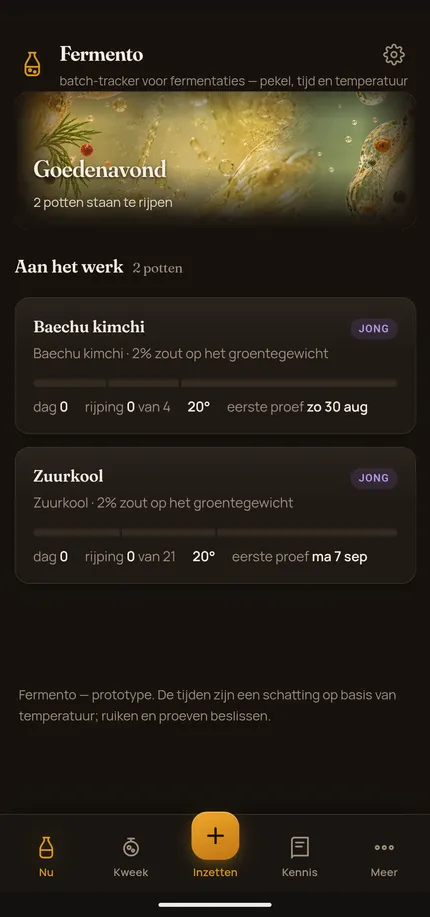
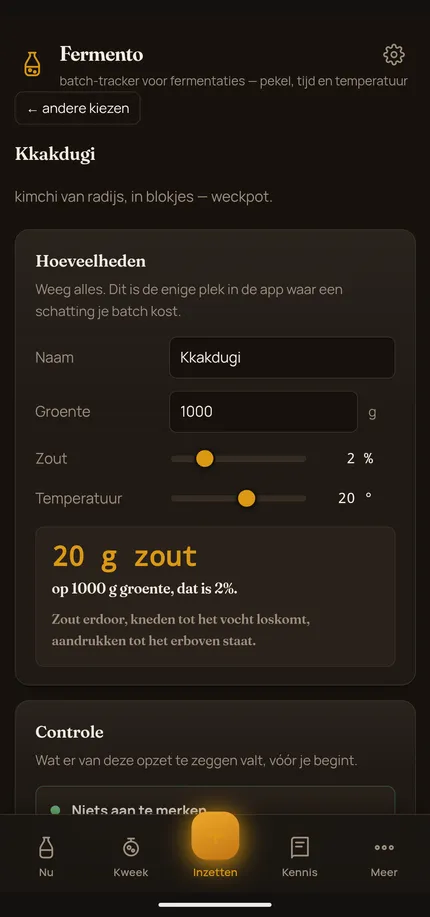
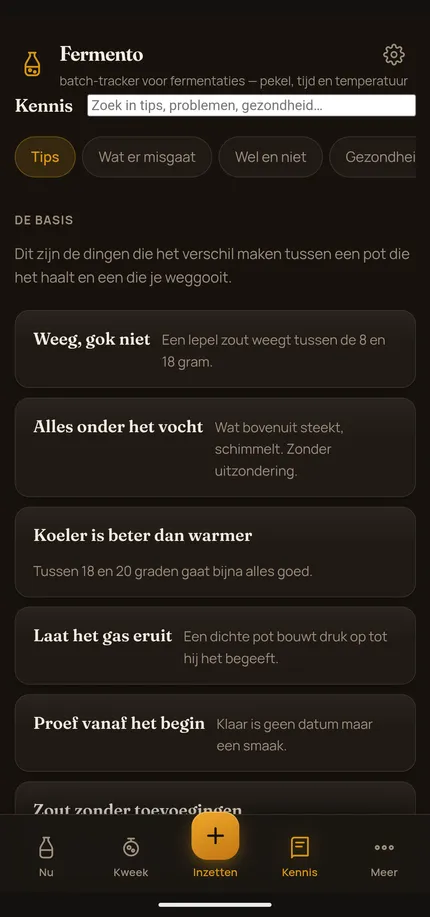
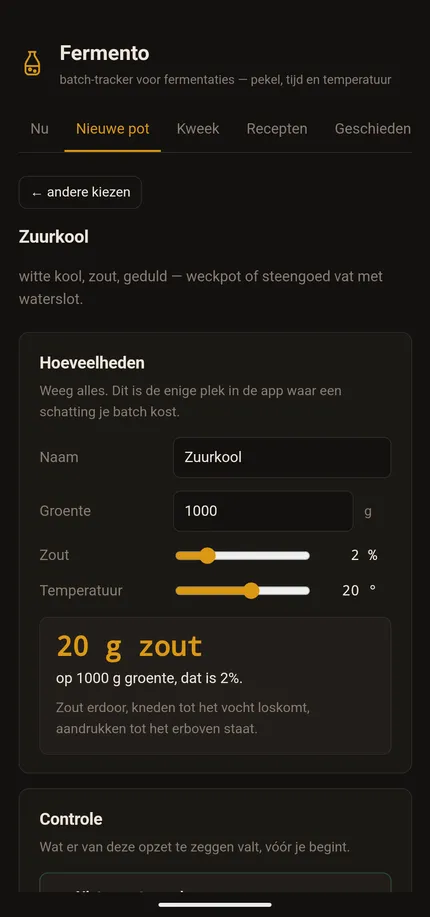
The same formula the app runs. Put in what it is where you are.
21 days
is how long it takes for you. Try 15 or 25.
No subscription. This app runs on your own device; there is no server behind it costing money every month.
Three jars free, forever. Complete for a one-off € 8.99. No subscription, no account, no adverts.
That sounds like hedging. It is the opposite: it is exactly why the numbers above are worth anything.
There is no thermometer in your phone and no pH meter in your jar. Everything the app knows, you typed in. Tell it 20 degrees where it is really 14 and it will calculate the wrong answer beautifully — with no way of noticing.
A good model, built on the growth curve of lactic acid bacteria and backed by a suite of 128 checks. But a model is still an average of how things usually go, and your cabbage is not an average cabbage.
An app claiming your jar is safe would be lying — it is not in the room. That is why every screen in Fermento says the same thing: the timings are a calculation, your nose and your tongue decide. When in doubt, it goes out. A head of cabbage costs two euros.
In plain terms: Fermento is a calculator with a memory, not a food inspector. It is not a food safety assessment, it is not medical advice, and it does not replace your own judgement. What ends up on the table is your call — and that is the only place that call belongs.
Because a day at 15 °C is not a day at 24 °C. Lactic acid bacteria work faster as it gets warmer, and the difference runs to a factor of four. A calendar counter says the same thing for both, which is exactly why the same sauerkraut turns out perfect one time and limp the next.
Yes, and that is not reassurance but a consequence of how it works. Within a day or two the acidity drops below the point where pathogens give up, and the salt holds them off until it does. What you do have to do: use enough salt, keep everything under the brine, and use your nose. Spoilage in a ferment does not hide.
No, and it could not. Fermento works out how far the ferment has come at the temperature you entered; it cannot see your jar, smell it or measure anything. Every number is a calculation on the data you typed in. Whether something reaches the table is your call — when in doubt, it goes out.
Fermento is an aid to fermenting, not a food safety assessment and not medical advice. Responsibility for what you make and eat is yours, as with any cookbook. If you feel ill after something you made yourself, see a doctor, not an app.
No. No account, no sign-up, no email address. Everything lives on your own device and goes nowhere. You can write your data out to a file and load it back.
Kahm is a thin, flat, white film on the brine: harmless, tastes dull, skim it off and carry on. Mould is fuzzy, stands up from the surface and has colour — blue, green, black or pink. Then the whole jar goes, not just the top layer.
Because two conventions run side by side. One takes the percentage of the water, the other of water and vegetables together. With one litre of water and 700 grams of vegetables that is 30 grams against 51. Fermento works on the total and always shows the other figure alongside.
Free for three jars at a time, with every recipe, every calculator and the full knowledge base. Fermento Complete is a one-off € 8.99 and lifts the limit, plus cultures, history, jar stock and the planner. No subscription.
Completely. There is no server, so there is nothing to connect to. That is also why it just works in a cellar with no signal.
We are working on it. Write to info@nonius.be and you will hear first — nothing else will happen with your address.
Three jars free. Complete € 8.99 one-off.
Three jars free, forever.Complete € 8.99 one-off — no subscription
Start